One of my hobbies is reading pseudepigraphical texts—and yes, it is as fun as it sounds. I’m particularly interested in texts that were found after the Restoration of the gospel, because when you find similarities in texts discovered after Joseph Smith produced all of this writing and theology that was supposed to be restoring ancient Christianity, and then ancient Christian documents come to light and give us a better view of what early Christians believed, that’s a great place to see if he was right or not.
The Book of Abraham is a book of scripture that there’s been a lot of controversy about. I’m not going to get into questions of translation and that sort of thing here, but what I want to point out is an interesting text that I read and its similarities to the Book of Abraham.
The Apocalypse of Abraham is generally dated to the first or second century AD and survives in later Slavonic manuscripts, apparently translated from an earlier Greek or possibly Hebrew text. More importantly for this comparison, it was not available to Joseph Smith. The text only entered modern scholarly publication in the nineteenth century, with a major German edition appearing in 1897 and the first English translation in 1898, more than fifty years after Joseph Smith’s death.
The Apocalypse of Abraham is thought to be pseudepigraphical; having read it myself, I would agree with that conclusion. But this is the sort of work that could contain a mixture of facts and true Abrahamic stories that were known at the time of writing, but since lost to the world. So, when similarities between the Apocalypse of Abraham and the Book of Abraham go beyond their obvious shared biblical background, they are either coincidence, part of a wider Abrahamic tradition, or possibly an indication that both texts relied on earlier traditions or sources.
There are similarities between these texts that clearly have a common source in the Bible or in Abrahamic traditions already available before Joseph Smith, so I am trying to distinguish those from the more particular details that caught my attention. I’ll just take the parts that stood out to me in chronological order.
Comparison 1 — Abraham’s Father and Five Pagan Gods
Book of Abraham
1:6 For their (Abraham’s fathers) hearts were set to do evil, and were wholly turned to the god of Elkenah, and the god of Libnah, and the god of Mahmackrah, and the god of Korash, and the god of Pharaoh, king of Egypt;
Apocalypse of Abraham
And he (Abraham’s father) made five other gods, and gave them to me…
Why it’s interesting
The Bible already associates Abraham’s father Terah with the worship of other gods, so the basic idolatry connection is not unique. What caught my attention is the more specific detail that both texts associate Abraham’s father or fathers with five pagan gods. This could certainly be coincidence, but the specific number is interesting.
Comparison 2 — Seeking God and Leaving His Father’s House
Book of Abraham
1:1-2 In the land of the Chaldeans, at the residence of my fathers, I, Abraham, saw that it was needful for me to obtain another place of residence;
And, finding there was greater happiness and peace and rest for me, I sought for the blessings of the fathers, and the right whereunto I should be ordained to administer the same; having been myself a follower of righteousness, desiring also to be one who possessed great knowledge, and to be a greater follower of righteousness, and to possess a greater knowledge, and to be a father of many nations, a prince of peace, and desiring to receive instructions, and to keep the commandments of God, I became a rightful heir, a High Priest, holding the right belonging to the fathers.
Apocalypse of Abraham
“Abraham, Abraham!” And I said: “Here am I.” And He said: “Thou art seeking in the understanding of thine heart the God of Gods and the Creator; I am He: Go out from thy father Terah, and get thee out from the house, that thou also be not slain in the sins of thy father’s house.”
Why it’s interesting
Genesis already records God commanding Abraham to leave his father’s house, so that fact by itself is not a unique parallel. Josephus also portrays Abraham as reasoning toward knowledge of the one Creator, rejecting the surrounding religion, and then leaving the Chaldeans.
What is more interesting to me is the way both of these texts place Abraham’s departure specifically in the context of seeking greater knowledge of the true God while rejecting the idolatrous world of his father. In the Book of Abraham, Abraham desires greater knowledge, righteousness, and instruction; in the Apocalypse of Abraham, God explicitly tells him, “Thou art seeking in the understanding of thine heart the God of Gods and the Creator,” immediately before commanding him to leave his father’s house.
There also seems to be a connection between Abraham’s father’s idolatry and danger to human life. Later in the Apocalypse of Abraham, Abraham sees:
“I saw there the likeness of the idol of jealousy, having the likeness of woodwork such as my father was wont to make, and its statue was of glittering bronze; and before it a man, and he worshipped it; and in front of him an altar, and upon it a boy slain in the presence of the idol.”
This is not the same event as the Book of Abraham: Abraham himself is not the victim in this later vision. But the combination of an idol like those made by Abraham’s father, an altar, and human sacrifice is an interesting thematic parallel to the world described in the Book of Abraham, where Abraham is threatened with sacrifice by idolatrous priests.
Visual Comparison — Just an Interesting Resemblance
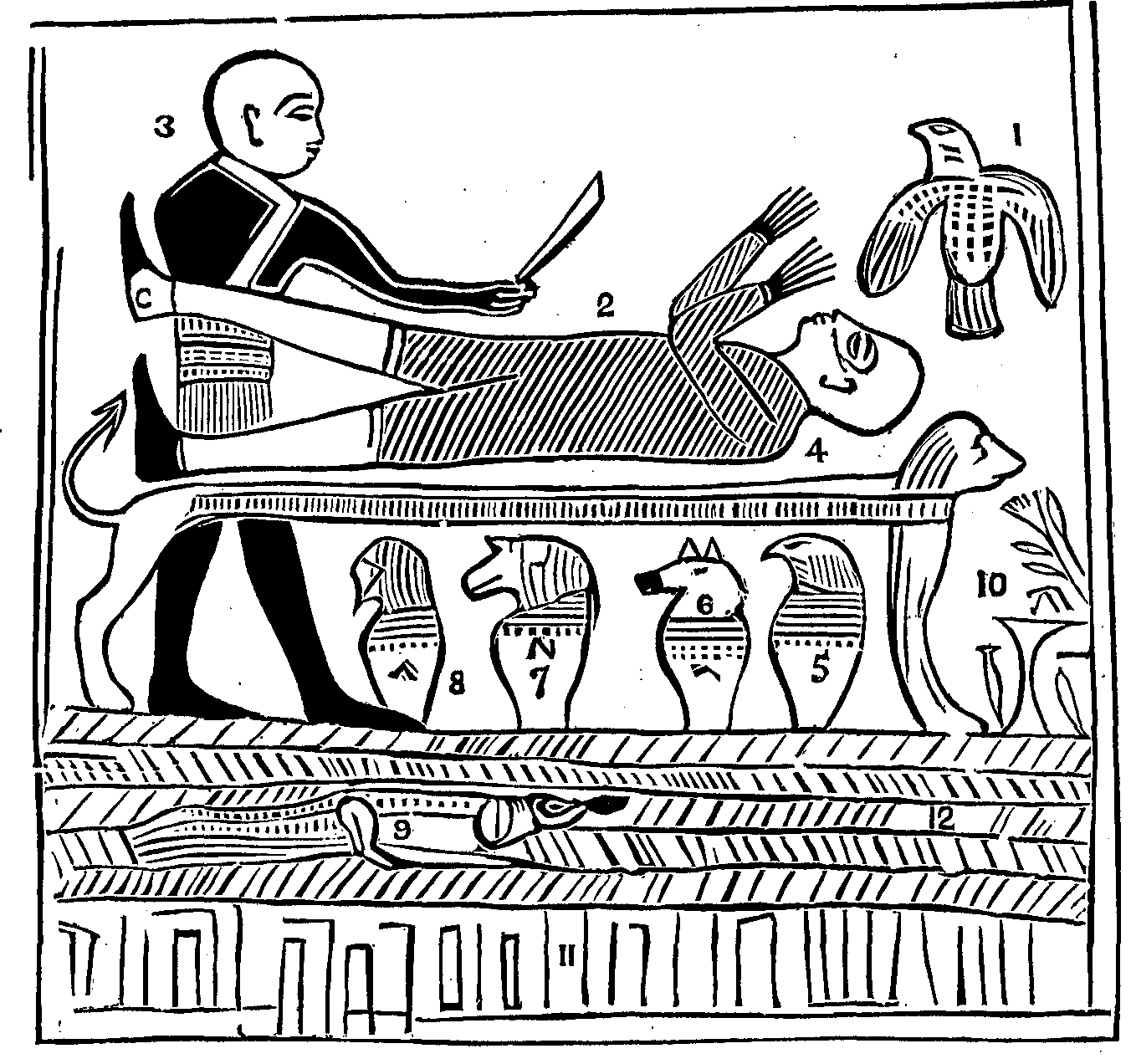
Book of Abraham — Facsimile No. 1
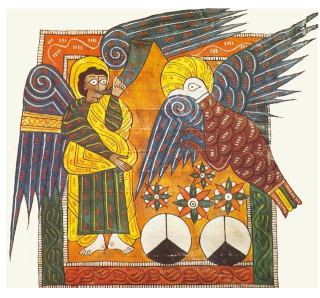
Apocalypse of Abraham Illustration
Why it’s interesting
The surviving Apocalypse of Abraham manuscript tradition also contains illustrations. The visual resemblance between the bird-like angel associated with Facsimile No. 1 and the winged imagery in this later Apocalypse of Abraham illustration caught my eye. I don’t attach much significance to this comparison—the illustration comes from the much later manuscript tradition rather than the original ancient composition—but it is visually interesting.
Comparison 3 — Abraham’s Vision of Creation and History
Book of Abraham
3:12 And he [God] said unto me: My son, my son (and his hand was stretched out), behold I will show you all these. And he put his hand upon mine eyes, and I saw those things which his hands had made, which were many; and they multiplied before mine eyes, and I could not see the end thereof.
Apocalypse of Abraham
Then a voice came to me speaking twice: “Abraham, Abraham!” And I said: “Here am I!” And He said: “Behold, it is I; fear not, for I am before the worlds, and a mighty God who hath created the light of the world. … I will shew thee the ages which have been created and established, made and renewed, by my Word, and I will make known to thee what shall come to pass in them on those who have done evil and (practised) righteousness in the generation of men.”
Why it’s interesting
The “Abraham, Abraham” and “Here am I” language has an obvious biblical precedent, so I don’t think that wording itself means much.
What interests me is what follows. In both texts God moves Abraham into a sweeping revelatory vision of His works: creation, the structure or history of the world, and, as the visions continue, premortal beings and a heavenly council. The broader visionary pattern is more interesting to me than the shared introductory wording.
Comparison 4 — Premortal Spirits and the Heavenly Council
Book of Abraham
3:22-23 Now the Lord had shown unto me, Abraham, the intelligences that were organized before the world was; … those that were spirits
3:22 and among all these there were many of the noble and great ones;
3:24 And there stood one among them [premortal spirits] that was like unto God, and he said unto those who were with him: We will go down, for there is space there, and we will take of these materials, and we will make an earth whereon these may dwell;
Apocalypse of Abraham
And I looked from the mountain in which I stood [downwards] to the sixth firmament, and saw there a multitude of angels, of (pure) spirit, without bodies.
These are they whom I have ordained to be born of thee and to be called My People.
This is my will with regard to those who exist in the (divine) world-counsel, and it seemed well-pleasing before my sight, and then afterwards I gave commandment to them through my Word. And it came to pass whatever I had determined to be, was already planned beforehand in this (picture), and it stood before me ere it was created, as thou hast seen.
Why it’s interesting
Heavenly councils and heavenly beings are not unique to either text; related motifs appear elsewhere in biblical and ancient Jewish literature. What interests me here is the combination of ideas within Abraham’s vision.
In both texts Abraham sees beings existing in a heavenly or premortal setting, and in both there are beings appointed or foreordained for particular purposes.
Book of Abraham 3 is the principal Latter-day Saint scriptural account of the premortal council in heaven.
The Apocalypse of Abraham similarly speaks of those who exist in a “divine world-counsel” and of God’s plan standing before Him before its earthly realization. The Word (Christ) also plays a role in carrying out what God has planned. The individual ideas have precedents elsewhere, but the cluster of ideas in two Abrahamic revelations is what caught my attention.
Comparison 5 — Reckoning of Time
Book of Abraham
3:4 that one revolution was a day unto the Lord, after his manner of reckoning, it being one thousand years according to the time appointed unto that whereon thou standest. This is the reckoning of the Lord’s time, according to the reckoning of Kolob.
Apocalypse of Abraham
And I said: “O Eternal [Mighty One]! And how long a time is an hour of the Age?” And He said: “Twelve years have I ordained of this ungodly Age to rule among the heathen and in thy seed; and until the end of the times it shall be as thou sawest. And do thou reckon and understand and look into the picture.”
Why it’s interesting
Both texts deal with divine reckoning of time, but this is a weak comparison. The Bible already contains the idea that God’s reckoning of time differs dramatically from ours—Psalm 90:4 compares a thousand years to a day, and 2 Peter 3:8 explicitly says that with the Lord one day is as a thousand years. So this parallel does not provide independent evidence of a connection between the two Abraham texts. It simply caught my eye while reading them.
At the very least, it can be said that the Book of Abraham fits well into the Abrahamic narrative. When my simple comparisons and many other comparisons
(just one more example)
are taken into account, I find it difficult to dismiss all of the similarities as mere coincidence. If the Book of Abraham were discovered in the sands of Egypt by archaeologists, there would be no problem fitting it into the collection of Abrahamic texts. The similarities are not overwhelming, but they’re the sort of things I would expect if the Book of Abraham contained authentic Abrahamic traditions or writings.
It could be said that I’m just reading too much into little cherry-picked nuggets found in two books that claim to cover the same subject matter, and so of course would have similar elements. But for anyone who has familiarity with these sorts of ancient texts, the themes and elements strike me as too similar to dismiss that easily. There are a lot of individuals who made up a lot of texts attributed to biblical figures over the centuries; pseudepigraphical literature is abundant. Take the Testament of Abraham, for example. The scholar M. R. James said the Testament of Abraham “employed existing Jewish legends, and for the apocalyptic (prophetic visions), he drew largely on his imagination.” I read enough of the Testament of Abraham to agree that it’s mostly a bunch of nonsense, but it serves as an interesting example to juxtapose with the Book of Abraham to show how difficult it is to make up an Abrahamic text and have it fit so well within the known and unknown Abrahamic literature.


Leave a comment